
Is Türkiye Entering the Era of Digital Gold?
Sima Baktaş, Attorney at Law — Umut Balcı, Attorney at Law
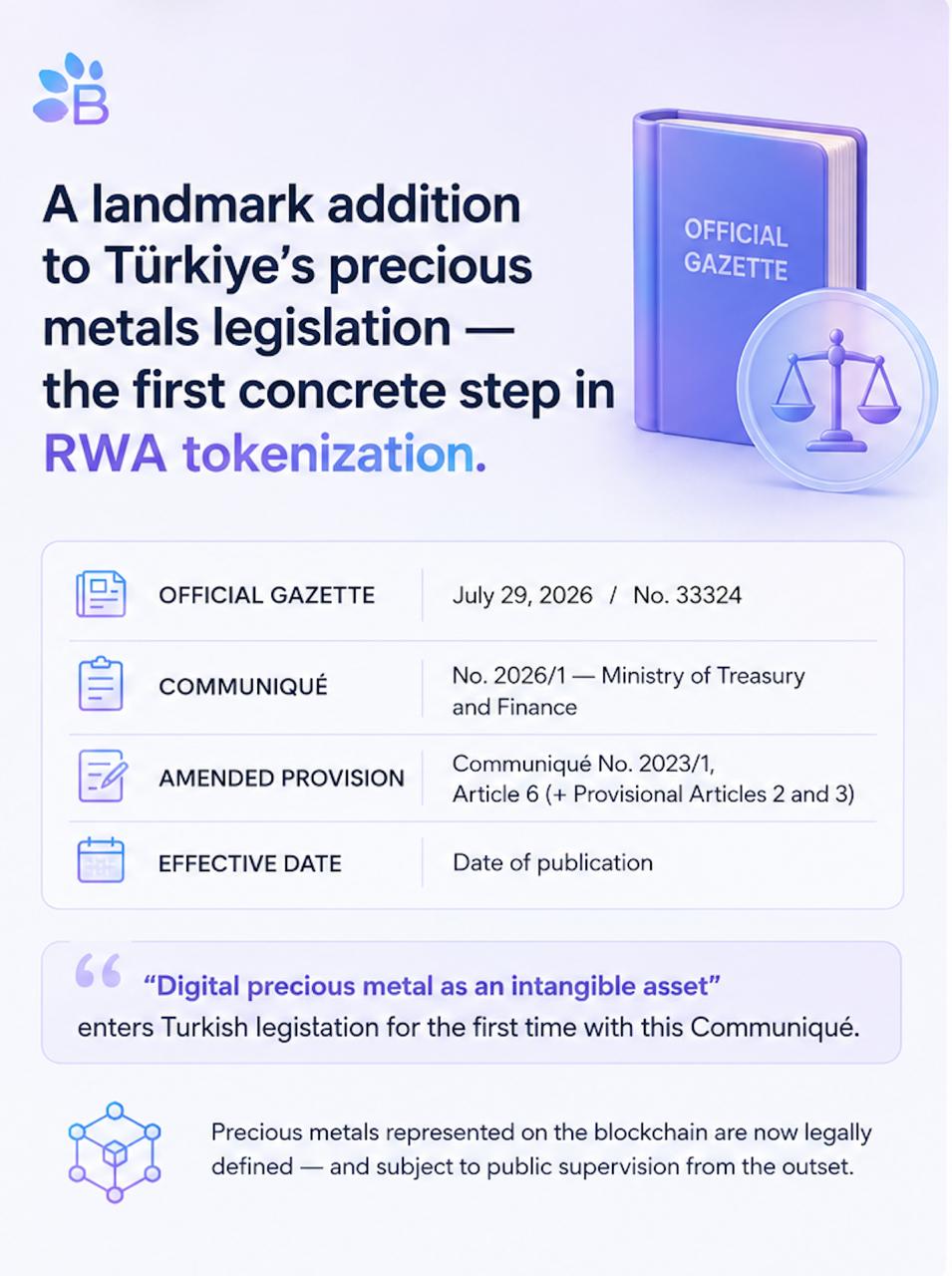
The Communiqué Amending the Communiqué on Precious Metal Standards and Refineries (Communiqué No: 2023/1) (No: 2026/1), published in the Official Gazette dated 29 July 2026 and numbered 33324, appears at first sight to be a technical amendment concerning the precious metals sector. In reality, however, it is one of the most concrete legal steps taken in Türkiye to date in relation to the digitalisation of real world assets (RWA).
With this Communiqué, precious metals represented on distributed ledger technology (DLT) infrastructure have, for the first time, been expressly regulated under Turkish legislation.
The regulation does not merely define a new product; it also raises a series of new questions at the intersection of crypto asset law and precious metals law:
Is digital gold now legally possible in Türkiye?
Will Crypto Asset Service Providers (CASPs) be able to list these products?
What will become of the legal status in Türkiye of existing gold-backed tokens such as PAXG (Pax Gold) and XAUT (Tether Gold)?
We address these questions in turn.
What did the 2023 Communiqué regulate?
The Communiqué on Precious Metal Standards and Refineries (Communiqué No: 2023/1), published in the Official Gazette dated 23 February 2023 and numbered 32113, established the technical and institutional infrastructure of the Turkish precious metals market.
That Communiqué set out in detail the principles governing the incorporation, operation, supervision and audit of refineries; the minimum fineness standards for standard unwrought precious metals (at least 995/1000 for gold, 99.9/100 for silver, and 99.95/100 for platinum and palladium); the duties of the Mint and Borsa İstanbul; and the Precious Metals Tracking System (KMTS).
The entire system, however, was built upon physical gold, silver, platinum and palladium. Neither blockchain technology nor the concept of digital representation featured in the legislation.
What exactly did the 2026 Communiqué change?
The new Communiqué did not add a new article to Communiqué No. 2023/1; it added two new paragraphs immediately after the first paragraph of the existing Article 6.
This choice matters. Article 6 of Communiqué No. 2023/1 is headed “Precious metals to be traded on the Exchange” and provides that the types, weights and fineness standards of such metals, together with the principles governing their purchase and sale, delivery, custody and clearing, are to be determined by the Exchange.
The digital precious metal has therefore been placed not in the legislation as a “next-generation digital asset”, but within the standards regime applicable to precious metals traded on the Exchange. In our view, this is a decisive choice for understanding the legal character of the product.
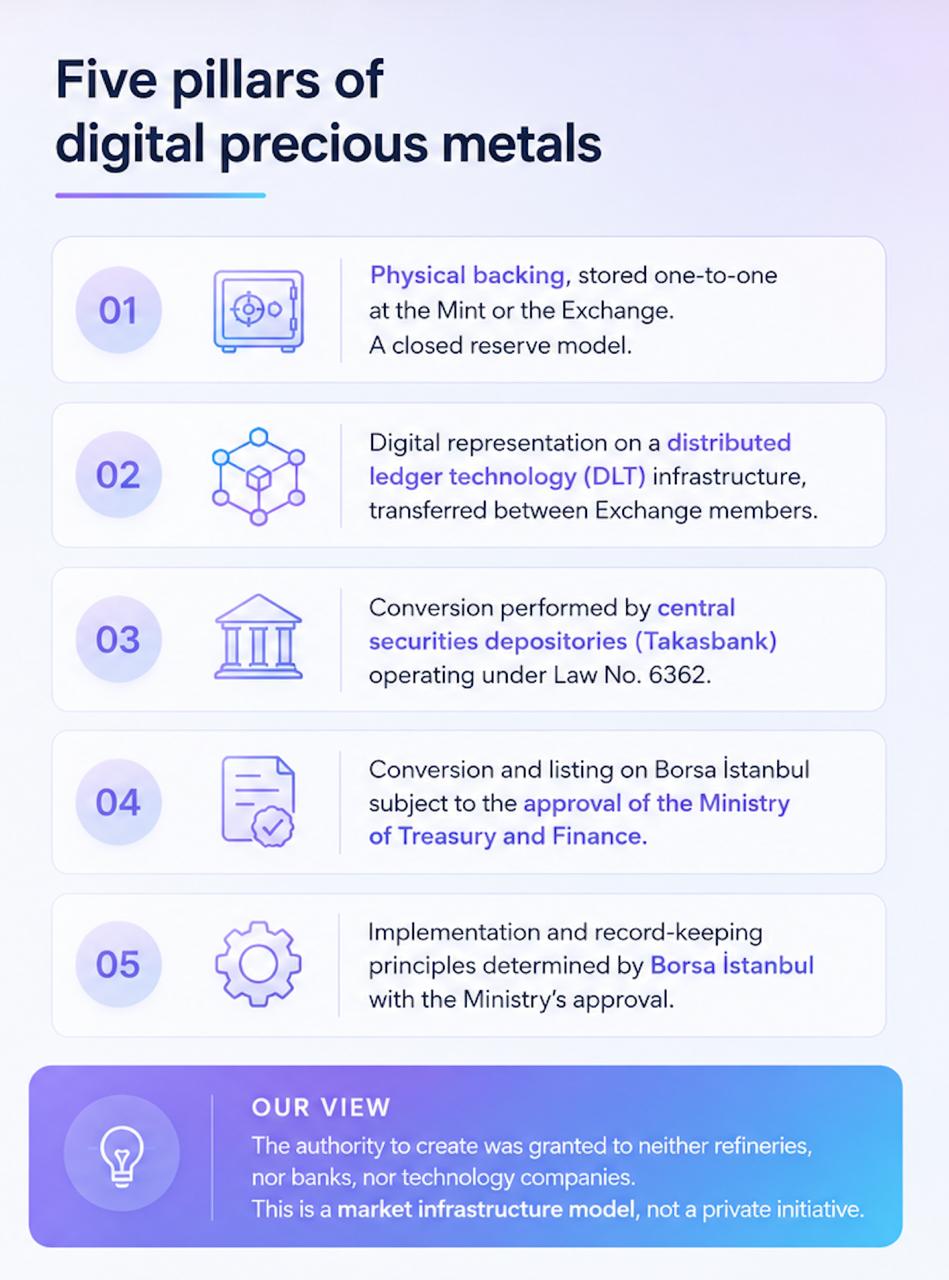
Under the newly added second paragraph, the conversion — by central clearing institutions operating under Capital Markets Law No. 6362 — of unwrought precious metal of a specified fineness and weight, whose one-to-one physical counterpart is held in custody with the Mint or the Exchange, into a “digital precious metal in the nature of an intangible asset” through a system with distributed ledger technology infrastructure enabling transfer among Exchange members, as well as the trading of such assets on the Exchange, is made subject to the favourable opinion (uygun görüş) of the Ministry.
The third paragraph provides that the procedures and principles governing implementation and record-keeping will be determined by regulations to be issued by the Exchange, upon obtaining the favourable opinion of the Ministry.
The five building blocks of the regulation
When the provision is broken down into its constituent elements, a tightly constructed structure emerges:
1. A physical underlying is mandatory. The digital asset must be backed by a one-to-one physical counterpart; that counterpart must be held in custody with the Mint or the Exchange and must qualify as unwrought precious metal of a specified fineness and weight. An unbacked or merely index-linked digital asset falls outside this definition.
2. The regulation is not technology-neutral; it is DLT-based. The system must have distributed ledger technology infrastructure.
3. The scope of circulation is limited. The transfer capability to be provided by the system is expressly defined as transfer “among Exchange members”. This points to a membership-based market structure rather than to retail investor circulation.
4. The conversion power has been monopolised. Only central clearing institutions operating under Law No. 6362 may carry out the digitalisation process. In practice, this means İstanbul Takas ve Saklama Bankası A.Ş. (Takasbank).
5. There is a two-stage administrative authorisation. The Ministry’s favourable opinion is required not only for trading on the Exchange, but also for the conversion process itself. These are two separate thresholds and should be addressed separately when structuring projects.
In addition, the authority that will issue the secondary regulation is Borsa İstanbul. No role has been assigned to the Capital Markets Board under this Communiqué.
Is this a crypto asset? And if not, why not?
The most striking feature of the Communiqué is that it constructs the digital precious metal by way of a negative definition. The provision excludes the asset in question from three separate categories cumulatively — an “intangible asset” which is:
not a capital markets instrument within the scope of Law No. 6362;
not a crypto asset conferring rights specific to capital markets instruments; and
not characterised as a crypto asset traded on platforms.
In public commentary, only the third element is usually quoted, and the first two exclusions are overlooked. Yet the scope of the provision can only be determined by assessing all three elements together.
This drafting choice is not coincidental. Under the definition added to Article 3 of Law No. 6362 by Law No. 7518 (Official Gazette: 2 July 2024, No. 32590), a crypto asset means “intangible assets which can be created and stored electronically using distributed ledger technology or a similar technology, distributed over digital networks and capable of expressing value or rights”.
As will be seen, this definition is extremely broad, and a digital precious metal created on DLT falls, on a literal reading, within it. It is precisely for this reason that the regulatory authority found it necessary to insert an express carve-out in order to separate the product from the Capital Markets Board’s crypto asset regime.
One point deserves emphasis here: this instrument is not a statute, but a communiqué issued by the Ministry of Treasury and Finance. Whether a broad definition introduced by statute may be narrowed by way of an administrative regulatory instrument is open to debate from the standpoint of the hierarchy of norms and the principle of legality. In our view, a complementary regulation or a principle decision from the Capital Markets Board should be awaited in order to resolve this uncertainty.
The nature of the two provisional articles
Provisional Article 3 — retrospective authorisation requirement. The Ministry’s favourable opinion is also required for the trading on the Exchange of assets that had already been converted into digital precious metals in the nature of intangible assets as at the date the Communiqué entered into force. The very existence of this provision is noteworthy, as it indicates that structures of this kind already exist in the market.
Provisional Article 2 — KMTS obligations. In the press, this provision has largely been reported as “an obligation imposed on all refineries”; its scope, however, is narrow. The provision targets only those legal entities resident in Türkiye which applied to the Ministry under the first and second paragraphs of Provisional Article 1 of Communiqué No. 2023/1 and whose applications are still under assessment. Refineries falling within this scope must:
apply to the Mint for KMTS registration within 1 month of the date of entry into force; and
within 1 month following approval of the registrations by the Mint, register with the KMTS all standard unwrought precious metals and minted precious metals produced before the registration date which have not yet been sold.
For the refineries concerned, the deadline falls on 29 August 2026.
Will CASPs (crypto platforms) be able to list these products?
As at today, there is no definitive answer to this question. The Communiqué neither states that these products may be traded on CASPs, nor that they may not.
The scheme of the regulation is nonetheless clear. At the centre of the structure sit the Mint, Borsa İstanbul, the central clearing institutions and the Ministry of Treasury and Finance; no role whatsoever is assigned to Crypto Asset Service Providers. In addition, the limitation of the transfer capability to transfer “among Exchange members” is determinative: CASPs are not Exchange members.
In our view, in its current form the digital precious metal has been designed as an exchange and clearing product, not as part of the CASP ecosystem. That said, since the Communiqué does not expressly prohibit CASPs, it remains legally possible for roles such as distribution or transaction intermediation to be assigned to licensed platforms through Exchange regulations and Capital Markets Board secondary legislation to be issued in due course.
What will happen to gold-backed tokens such as PAXG and XAUT?
In our view, this is the consequence of the Communiqué that will attract the most debate.
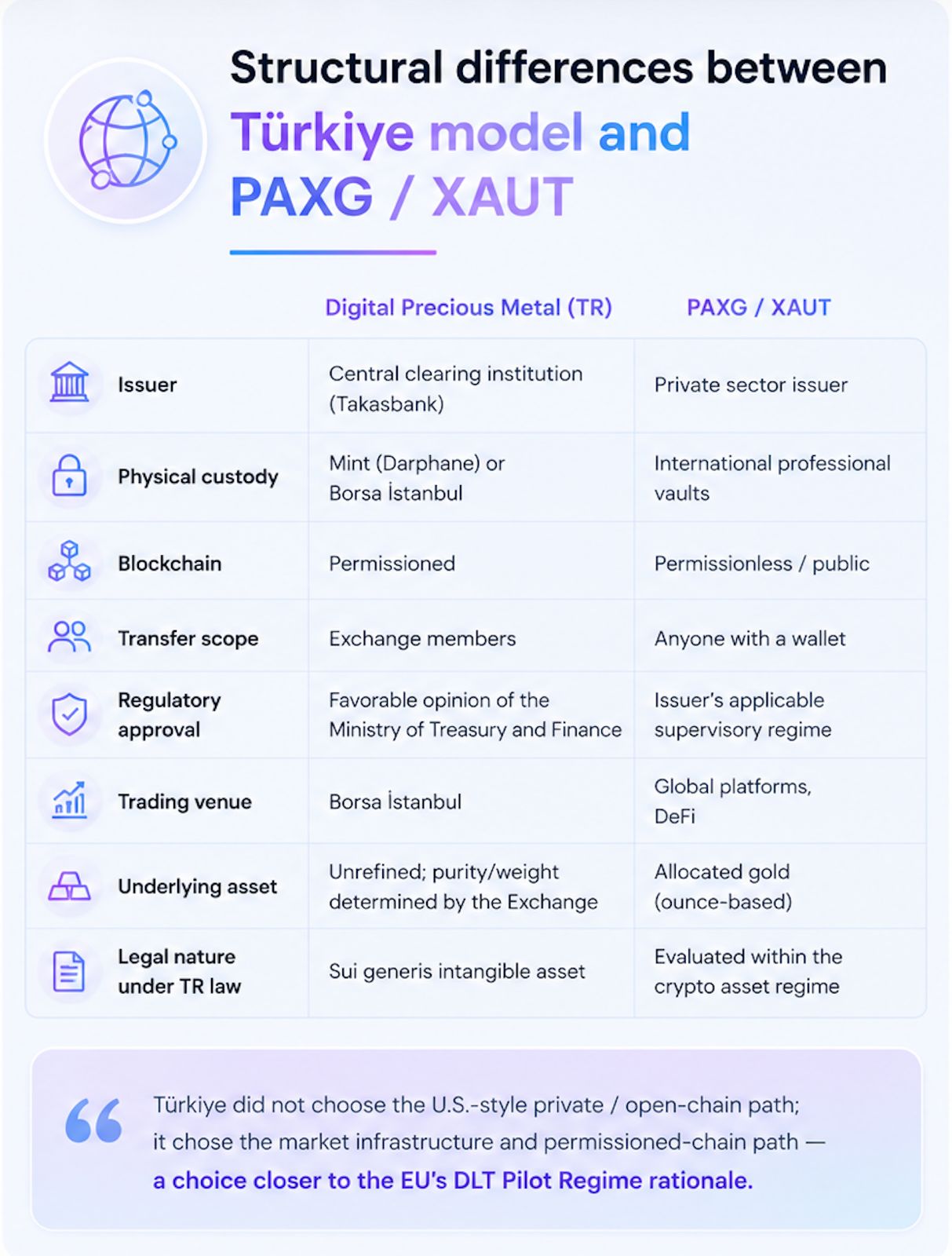
PAXG and XAUT, today the most widely used gold-backed tokens globally, are also backed by physical gold. According to Paxos’ disclosures, each PAXG token represents one fine troy ounce of a London Good Delivery gold bar held in professional vaults in London, and holders can be matched to bars identified by serial number. XAUT, for its part, is issued by TG Commodities Limited within the Tether group, with the underlying gold held in vaults in Switzerland.
At first sight, this structure resembles the model defined in the new Communiqué. The difference, however, is structural. Under the new Communiqué, a digital precious metal must:
be backed by physical precious metal held in custody with the Mint or the Exchange;
be created by central clearing institutions operating in Türkiye; and
be admitted into the system with the favourable opinion of the Ministry.
None of these three elements is present in PAXG or comparable foreign-issued tokens. The underlying gold is not held in Türkiye, the token is not created by Turkish central clearing institutions, and the product is not issued under Turkish legislation.
Accordingly, in our view the new Communiqué does not directly alter the legal status of PAXG and XAUT. These products will continue, as they do today, to be assessed within the framework of the Capital Markets Board’s crypto asset regime.
The provision that really matters for listing committees
The point that in fact requires attention in practice is this: the listing regime applicable to CASPs is regulated in detail by Communiqués No. III-35/B.1 and No. III-35/B.2, published in the Official Gazette dated 13 March 2025 and numbered 32840.
Pursuant to Article 21 of Communiqué No. III-35/B.2, one of the conditions that a crypto asset must satisfy in order to be listed on a platform is that no restriction or prohibition has been imposed by the relevant authorities in relation to the issuance of the underlying asset of the crypto asset or to its being made the subject of purchase and sale transactions. Article 22 of the same Communiqué requires platforms to establish a written listing procedure, to enter into force by resolution of the board of directors, and to prepare an assessment report for each asset through the listing committee.
The legal question that arises is this: by imposing a Ministry authorisation requirement on the digital representation of gold, does Communiqué No. 2026/1 give rise to a “restriction” within the meaning of Article 21 in respect of gold-backed tokens?
In our view, it does not. The scope of the Communiqué is limited to the conversion, by central clearing institutions in Türkiye, of physical metal held in custody with the Mint or the Exchange; it contains no general prohibition or restriction concerning the underlying assets of tokens issued abroad.
However, making and documenting that assessment is, as a matter of law, the direct responsibility of the platforms’ listing committees. We therefore recommend that licensed platforms update their existing assessment reports concerning gold-backed tokens in the light of Communiqué No. 2026/1, and record their reasoning in writing.
It should also be noted that this debate is not confined to foreign products: alongside PAXG, gold-gram-linked domestic tokens are also traded on licensed platforms in Türkiye. The issue is therefore less one of a “domestic versus foreign” distinction than one of how the boundaries between two parallel legal regimes will be drawn.
The period ahead: three possible scenarios
1. A domestic-system-first model. The Treasury and the Capital Markets Board may in future opt for an approach under which only digital precious metals created in Türkiye may be traded. In that event, the listing of foreign gold tokens could be restricted.
2. A coexistence model. In our view, this is the most likely scenario. The new Communiqué regulates only digital precious metals to be created in Türkiye, while foreign-issued tokens such as PAXG continue to be assessed separately under the Capital Markets Board’s crypto asset regulations. On this basis, the two systems would operate in parallel.
3. A hybrid model. The digital precious metal is created by a central clearing institution, physical custody is maintained with the Mint or the Exchange, and investor transactions are executed through licensed CASPs. This model would both preserve investor habits and maintain public oversight. It would, however, require the current “transfer among Exchange members” limitation to be widened by way of legislative amendment.
What market participants should do next
Licensed CASPs (crypto platforms authorised by the Capital Markets Board): update your listing committee assessment reports concerning gold-backed tokens in the light of Communiqué No. 2026/1 and put your reasoning in writing. Update your listing committees’ listing policies and procedures.
Holders of already-digitalised assets: under Provisional Article 3, the Ministry’s favourable opinion is required for trading on the Exchange; review your existing structures.
Refineries with pending applications: monitor the KMTS application and registration timetable under Provisional Article 2.
Tokenisation projects: the operational framework will be set by the regulation to be issued by Borsa İstanbul; plan your project timetables accordingly.
Conclusion
The Communiqué dated 29 July 2026 is not merely a technical regulation concerning the precious metals market. It should be regarded as one of the first concrete legal steps taken by Türkiye in the field of real world asset tokenisation.
At the same time, while the regulation deliberately separates digital precious metals from the existing crypto asset regime, it leaves significant uncertainty as to the role licensed CASPs will play in this new ecosystem and as to the status in Türkiye of international gold-backed tokens such as PAXG.
For this reason, the regulations to be issued in the period ahead by Borsa İstanbul, the Ministry of Treasury and Finance and the Capital Markets Board will shape not only the digital precious metals market, but also the future of the crypto asset ecosystem and of RWA tokenisation.
In our view at GlobalB Law, this regulation marks the beginning of a new era in which blockchain technology will be used in Türkiye not only for crypto assets, but also for the secure and regulated digital representation of physical assets. The role of CASPs, the legal status of foreign gold-backed tokens and the development of the tokenisation ecosystem will, in particular, be among the most important legal debates of the coming period.
Relevant legislation and sources
Communiqué Amending the Communiqué on Precious Metal Standards and Refineries (Communiqué No: 2023/1) (No: 2026/1) — Official Gazette: 29/7/2026, No. 33324
Communiqué on Precious Metal Standards and Refineries (Communiqué No: 2023/1) — Official Gazette: 23/2/2023, No. 32113
Communiqués No. III-35/B.1 and No. III-35/B.2 on Crypto Asset Service Providers (CMB announcement) — Official Gazette: 13/3/2025, No. 32840
Law No. 7518 Amending the Capital Markets Law — Official Gazette: 2/7/2024, No. 32590
This article has been prepared for general information purposes only and does not constitute legal advice. For an assessment of specific circumstances, please contact us.