
GLOBALB LAW | LEGAL BLOG
EU Inc. (EU Company): A New Era for Setting Up a Company in Europe
Legal Framework, Practical Guide and Roadmap for Turkish Entrepreneurs
18 March 2026 • GlobalB Law Legal Team • Corporate Law & International Transactions
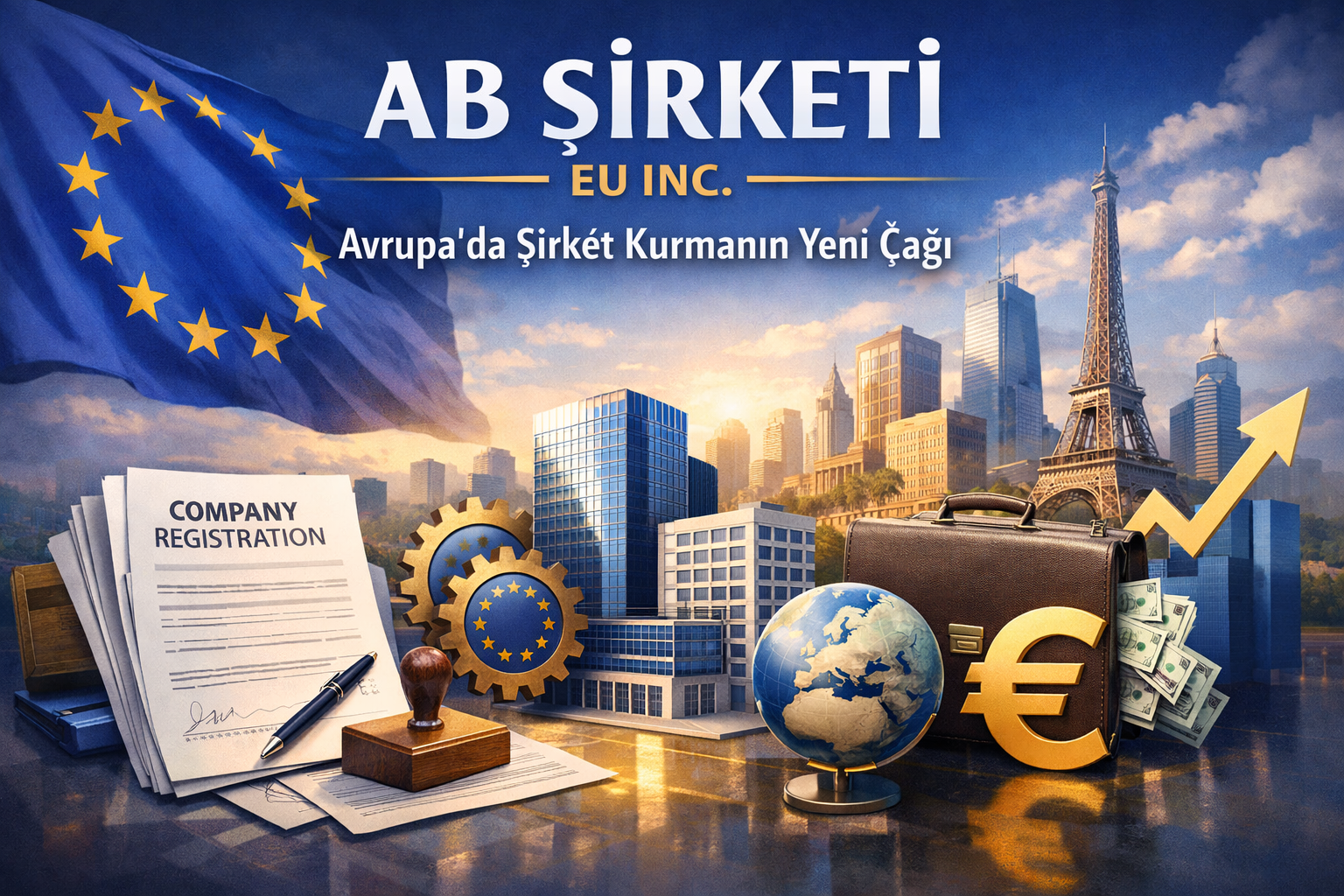
On 18 March 2026, the European Commission published a comprehensive legislative package known as "EU Inc." (EU Company). The package offers an optional, single and harmonised company law framework for companies that operate, or wish to operate, in the European Union. The framework is intended to be adopted as an EU regulation. It is designed not to compete with existing national regimes but to provide a genuine alternative alongside them.
At present, any entrepreneur who wants to grow within the EU has to navigate 27 different national legal systems and more than 60 company types. EU Inc. aims to end this fragmentation by cutting incorporation time to 48 hours and the cost to under EUR 100, and by moving the company's entire life cycle onto a digital platform.
This article provides an in-depth analysis of the legal framework, a practical roadmap for Turkish entrepreneurs and Türkiye-based companies, and warnings about potential risks.
GUIDANCE NOTE
This article is based on the European Commission's official press release of 18 March 2026, the EU Competitiveness Compass (January 2025) and Mario Draghi's report on European competitiveness. The legislative process for the EU Inc. proposal has not yet been completed, and some of its provisions may change in the final text.
2. Why EU Inc.? Anatomy of the Problem
To make sense of the EU Inc. proposal, we first need to set out clearly the problems created by the current landscape.
2.1. A Fragmented Legal Landscape
The European Union has delivered one of the world's most far-reaching economic integration projects, but that integration has not yet extended to corporate law. There is the SARL in France, the GmbH in Germany, the BV in the Netherlands and the SRL in Italy. Each country has its own incorporation procedures, different minimum capital requirements, separate share transfer mechanisms and distinct governance structures. For any company wishing to carry out cross-border transactions, this means time, cost and legal uncertainty.
2.2. The Cost in Numbers
Problem Area
Current Position
Incorporation time
Ranges from 1 day to as long as 3 months, depending on the Member State
Legal advisory costs
Average between EUR 5,000 and EUR 50,000 for cross-border incorporations
Number of company forms
More than 60 different company types exist across the EU
Compliance burden
Each entry into a new market triggers fresh application, translation and notarisation requirements
Preferred alternative
Many EU start-ups opt for Delaware (US) or Cayman Islands structures
This is precisely the point Mario Draghi stressed repeatedly in his report published in October 2024: fragmentation weakens Europe's global competitiveness and prevents innovative companies from scaling up.
3. What Is EU Inc.? The Legal Framework
3.1. Core Features
In terms of legal form, EU Inc. is set out as an EU regulation. Unlike directives, regulations apply directly in all Member States without waiting for approval by national parliaments. This choice is in keeping with the spirit of the proposal: a single, harmonised framework with no intermediary layer.
Three core features stand out for EU Inc.:
• Optionality: It does not abolish existing national company forms; it gives entrepreneurs an additional option.
• Digital-by-default: All incorporation, management and liquidation procedures are conducted digitally.
• Free choice of incorporation: An EU Inc. company may be registered in any Member State, and that choice remains valid in the other Member States.
3.2. EU Inc. Compared with Existing EU Instruments
EU Inc. is not an entirely new concept, but it is designed to remedy significant shortcomings in existing instruments. The table below provides a comparative assessment:
Instrument
Assessment
SE (Societas Europaea)
An EU company form that has existed since 2004, but it is limited to public companies, carries a minimum capital requirement of EUR 120,000 and has seen very limited use.
SUP (Single-Member Private Limited Company)
The Single-Member Private Limited Liability Company directive, proposed in 2014, never entered into force because of resistance from Member States.
EU Inc.
Takes the form of a regulation, is open to all company types, has no minimum capital requirement, allows incorporation in 48 hours, and is fully digital and optional. It is intended to be up and running by 2028.
4. Key Features: Detailed Legal Analysis
4.1. Fast, Digital Incorporation
Under EU Inc., companies will be incorporated on the following terms:
• Timing: Completed within 48 hours of registration.
• Cost: Capped at a maximum of EUR 100.
• Minimum capital: No minimum unpaid capital requirement will be imposed.
• Method: Incorporation can be carried out entirely online and remotely, with no requirement for physical presence.
• Language: Multilingual support will be provided through the EU's common language infrastructure.
Legal assessment: In Türkiye, incorporating a joint-stock company (A.Ş.) under Article 335 et seq. of the Turkish Commercial Code (TCC) takes 2 to 4 weeks on average and involves significant notarial, trade registry and minimum capital costs. With EU Inc., this process becomes dramatically shorter in any of the 27 EU countries. In start-up-friendly Member States such as Ireland, Estonia and the Netherlands in particular, opting for EU Inc. will offer a significant advantage even compared with existing national forms.
4.2. Once-Only Reporting and an Integrated Register
To reduce administrative burdens, the EU Inc. proposal adopts a "report once, valid everywhere" principle. Accordingly:
• Company information will be submitted once, through an EU interface connecting national trade registers.
• A tax identification number and a VAT number will be allocated automatically, without a separate application.
• In a second phase, a single central EU register is planned.
This will be a major convenience, particularly for companies that want to operate in several EU countries at the same time and currently have to grapple with separate bureaucratic procedures in each country.
4.3. Flexible Share Structures and Investor Protection
From the investment ecosystem's perspective, one of the most important elements of the EU Inc. proposal is its treatment of different share classes. Accordingly:
• EU Inc. companies will be able to create multiple share classes carrying different economic or voting rights.
• This structure allows founders to raise outside capital while retaining control of the company.
• It will become possible to put in place defence mechanisms against hostile takeovers.
• The notarisation requirement for share transfers is being abolished; digital approval mechanisms will be valid instead.
• Financing transactions (capital increases, share issuances, etc.) are being moved to fully digital procedures.
Legal assessment: Multiple share classes are possible under the Turkish Commercial Code (TCC), but Turkish law lags behind European and US practice, particularly with regard to share buy-back restrictions and liquidation preference arrangements. The flexibility offered by EU Inc. will significantly strengthen founders' positions in early-stage funding rounds (Series A, B).
4.4. Employee Stock Option Plans (ESOPs) and Taxation
In terms of competing for talent, the most significant provision of the EU Inc. proposal is the new framework for employee stock option plans (ESOPs) that can be applied across the EU.
HOW ESOP TAXATION WILL WORK
Current problem: In many EU countries today, ESOPs are taxed at the point the shares are granted (the vesting stage). This means employees face a tax bill before they have converted anything into cash.
EU Inc. solution: Tax will arise only on the proceeds of an actual sale of the shares, and only at that stage. Employees will therefore not face a tax bill before realising a real economic gain.
EU-wide validity: The need to prepare separate ESOPs for employees in different Member States will disappear; a single EU-wide plan will suffice.
This provision turns ESOPs into a highly strategic recruitment tool, particularly for technology start-ups seeking to hire qualified software engineers, data scientists and product managers.
4.5. Easier Liquidation and Restart
A healthy entrepreneurial ecosystem needs not only easy incorporation but also a smooth "exit" mechanism. EU Inc. addresses this need through the following provisions:
• Fully digital liquidation procedures will be available.
• Simplified insolvency procedures are envisaged for innovative start-ups.
• The aim is to enable founders to set up a new company faster and at lower cost after a failed venture.
This approach is consistent with the "embrace failure" culture established particularly in Northern Europe and will help Europe build a livelier, more dynamic entrepreneurial ecosystem.
4.6. Employee Rights and Social Safeguards
One of the most sensitive political balancing acts in the EU Inc. proposal is how it deals with national employment law. The Commission's position is clear:
• National employment law and social security legislation are not disapplied.
• The employee protections of the Member State of registration, including co-determination rights, will apply in full to EU Inc. companies.
• An "anti-abuse list" (blacklist) will be drawn up to prevent the EU Inc. framework from being used to obtain tax advantages or avoid social safeguards.
This provision is vital for overcoming resistance within the EU institutions from countries with strong traditions of employee representation, such as Germany and France.
4.7. Full Access to the Internal Market and Non-Discrimination
Once registered, EU Inc. companies will be entitled to equal treatment with national companies in all 27 Member States. A list of prohibited practices, described in the proposal as a "blacklist", is intended to prevent local rules that discriminate against EU Inc. companies.
In addition, Member States are given the option of granting EU Inc. companies access to stock exchanges. This could greatly simplify initial public offering (IPO) processes.
5. Roadmap for Turkish Entrepreneurs and Companies
Although Türkiye is not an EU member, it has deep commercial ties with the EU market. The Customs Union relationship has led Turkish-origin entrepreneurs, particularly in the technology and finance sectors, to choose to structure themselves in the EU. EU Inc. represents an opportunity that could fundamentally change this dynamic.
5.1. Who Can Benefit?
EU citizenship is not required to use the EU Inc. framework. All entrepreneurs, including nationals of non-EU countries, will be able to set up an EU Inc. company in any Member State. Seen from this angle, the scenarios directly relevant to Turkish entrepreneurs are as follows:
Scenario A: Turkish Start-ups Seeking to Expand into the EU Market
As part of an EU market entry strategy, an EU operating company can be set up through EU Inc. in addition to a Türkiye-based holding structure. This structure offers EU investors a familiar legal framework, makes it easier to sign contracts in the EU market and simplifies VAT compliance.
Scenario B: Start-ups Seeking Investment
In Series A and later funding rounds especially, European and American venture capital (VC) funds prefer to invest in companies structured in a familiar legal environment. The multiple share class structure and ESOP mechanism offered by EU Inc. are very well suited to meeting investors' requirements.
Scenario C: Retaining Talent in Europe
For Turkish companies that employ, or plan to employ, staff in Europe, the EU-wide ESOP mechanism offered by EU Inc. can remove the option tax burden that varies from country to country. This becomes a critical cost advantage, particularly for technology companies working with multi-country teams.
Scenario D: Two-Way Investment Structures
For investment flowing from Türkiye to the EU or from the EU to Türkiye, using EU Inc. as a holding structure can provide legal transparency for both EU and Turkish investors. The structure needs to be assessed with a tax adviser, particularly with regard to double taxation treaties (DTTs) and dividend repatriation.
5.2. Practical Steps: Where to Start with EU Inc.?
STEP-BY-STEP EU INC. INCORPORATION GUIDE (Framework Expected to Enter into Force)
1. Choice of Member State: An EU Inc. company may be registered in any EU Member State. Depending on the scenario and tax optimisation, Estonia (e-Residency infrastructure), Ireland (corporate tax advantage), the Netherlands (holding structures) or Germany (strong market access) stand out.
2. Digital Application: The incorporation form will be completed on the EU's central digital platform, and identity verification will be carried out remotely.
3. Tax ID Allocation: A VAT number and tax ID will be provided automatically; no additional application will be required.
4. Designing the Share Structure: Different share classes (Class A with restricted voting rights, Class B with full voting rights, etc.) will be defined in the company's articles of association.
5. ESOP: The employee option plan will be established by board resolution and given EU-wide validity.
6. Operations: The EU Inc. company will be able to operate freely throughout the EU, subject to the employment law of its Member State of registration.
5.3. Points to Watch and Risks
While EU Inc. offers significant opportunities, it also carries risks that call for careful assessment.
Risk Area
Assessment and Recommendations
Limits of Tax Optimisation
Registering an EU Inc. company in a low-tax Member State solely to obtain a tax advantage may cause problems under the OECD BEPS rules and the EU's anti-abuse provisions. It is recommended that the company maintain genuine economic substance in the country where it is actually registered.
Local Employment Law Obligations
EU Inc. does not disapply national employment law. When choosing the place of registration, the target country's employee representation (co-determination) rules, severance pay obligations and trade union rights should be taken into account.
Transitional Uncertainties
The EU Inc. proposal is still going through the legislative process. It will be negotiated in the European Parliament and the Council, and although agreement is targeted by the end of 2026, the final text may differ from the elements described in this article.
Türkiye–EU Bilateral Legal Compliance
For an EU Inc. company with Turkish shareholders, compliance with the Turkish Commercial Code and the Capital Markets Law should be assessed separately for the stages that take place in Türkiye.
VAT and Double Taxation
Although intra-EU VAT transactions are simplified through a single interface, the provisions of the relevant bilateral tax treaties need to be examined separately for dividend payments and interest transfers between Türkiye and the EU.
6. Beyond EU Inc.: Other Components of the 28th Regime
The EU Inc. proposal is being introduced not on its own but as part of a broader policy package. The Communication published by the Commission on the same date sets out the other components of the "EU Company (28th Regime)" framework:
6.1. European Business Wallet
This project aims to maximise companies' digital interaction with public authorities. Its goal is to allow EU Inc. companies to handle document submission, certificate issuance and administrative applications through a single digital platform.
6.2. Remote Working Framework
The Commission plans to present, in the coming period, a Fair Labour Mobility Package that will facilitate fully (100%) remote cross-border working for innovative start-ups and scale-ups.
6.3. Access to Capital
The Savings and Investment Union, the revision of the European Venture Capital Funds (EuVECA) framework and the review of pension fund investment rules aim to strengthen private capital flows, particularly to early-stage start-ups.
6.4. Tax Alignment
The Head Office Tax (HOT) system for small and medium-sized enterprises and the BEFIT (Business in Europe: Framework for Income Taxation) initiative, which aims to create a single EU-wide legal framework, are the tax policy measures that complement EU Inc.
7. Timeline and Next Steps
In forecasting when EU Inc. will be implemented, the current legislative structure and EU decision-making processes need to be taken into account.
Date / Period
Expected Development
18 March 2026
The Commission publishes the EU Inc. proposal and the Communication
2026 (H1)
Discussions will begin in the European Parliament's Committee on the Internal Market and Consumer Protection
2026 (H2)
The Council (Member States) presidency will continue negotiations
End of 2026
The Commission's target date for agreement, subject to political negotiations
2027 (Expected)
Publication of the regulation in the Official Journal of the European Union
2027–2028
Member States put implementing infrastructure in place
2028 (Target)
A fully functional EU Inc. regime, in line with von der Leyen's "One Europe – One Market" objective
Important warning: Negotiations on EU legislation can take longer than expected, and directives and regulations sometimes undergo fundamental changes. The final provisions of the EU Inc. proposal may therefore differ from the information in this article.
8. Conclusion: Choosing Europe Again
EU Inc. is not merely a reform of company incorporation procedures. It is a strong political message about where Europe wants to position itself in global competition. As a response to the fragmentation created by 27 national regimes, it takes concrete steps built around digitalisation, flexibility and entrepreneur-focused design.
EU Inc. opens a new window for Turkish entrepreneurs, technology companies and Turkish funds targeting investment in the EU. If structured correctly, it offers a real opportunity for transformation in terms of capacity to attract investment, access to talent and the advantages of the internal market.
At the same time, it is critical to follow this proposal closely while it is still under negotiation, and to review the structure with specialist legal advice once the final text has been settled.
HOW CAN GLOBALB LAW HELP?
At GlobalB Law, we advise Turkish start-ups and companies developing EU market entry strategies on the following matters:
• Designing EU incorporation structures and choosing the Member State
• Preparing multiple share class structures and investor agreements
• Assessing ESOPs under EU and Turkish law
• Legal and tax analysis of two-way Türkiye–EU investment structures
• Monitoring the legislative process for the EU Inc. regulation and providing up-to-date legal assessments
You may contact GlobalB Law with your advisory requests.
Sources and References
• European Commission, "EU Inc. Önerisi" [EU Inc. Proposal] press release, 18 March 2026, Brussels (IP/26/614)
• Mario Draghi, "Avrupa Rekabet Gücünün Geleceği Raporu" [The Future of European Competitiveness], European Commission, October 2024
• European Commission, "Rekabet Gücü Pusulası" (Competitiveness Compass), January 2025
• European Council Conclusions, March 2025
This article does not constitute legal advice and has been prepared for information purposes only.